
Now, let me put you in a moment you’ve likely experienced at least once before: you bend down to tie your shoe, stand up from the couch, or reach into the back seat of your car, only to have your back suddenly seize up in painful agony.
One second, you're going about your day. The next, you're wondering what just happened to your body.
Did I slip a disc? Did I injure something? Or maybe even, is this what getting older feels like?
And while the pain alone can be terrifying, so can the uncertainty that comes with it. Can you go for that hike this weekend? Will your next workout make it worse? Should you avoid bending that way from now on? Should your doctor be on speed dial?
Suddenly, a movement you've done thousands of times becomes something you think twice about.
I want you to consider a different possibility:
What if that one movement wasn't the whole story?
Think about what your body does all day. You sit in the car on your commute, sit at your desk, drive home, and settle onto the couch. Five, eight, maybe ten hours in a similar position. Then you head out for a run, play a recreational basketball game, or spend a Saturday hiking in the mountains, asking your body to move in all sorts of different ways.
Your fascia is constantly adapting to the positions and movements you repeat. It can essentially “mold” into the shape that you utilize the most. Over time, tension accumulates and restrictions form, influencing how freely you can move or how your body compensates when you ask it to do something different.
This doesn't mean you have to rush out to buy a standing desk or start believing your body is a fragile butterfly because of your desk job. It just means your body has adapted to what you’ve asked of it, and sometimes those adaptations leave you with less freedom of movement than you'd like.
After hundreds, or even thousands of times bending, twisting, reaching, or moving in a way that aggravated those restrictions or limitations, there comes a day that your back says, “Enough! It’s not safe to move this way anymore!” And suddenly—BAM—you feel pain, seemingly “out of nowhere.”
This is where understanding your body can change your entire relationship with pain.
Instead of immediately asking, "What's wrong with me?" you can start asking, "What's happening in my body, and what can I do to help?"
That shift matters.
Because when you understand how your body adapts, you have more options. You can explore where you're holding tension, work on areas that may be limiting your movement, and give your body opportunities to develop new patterns. Sure, you can also check in with your doctor for extra evaluation. But pain alone doesn't tell you what's happening inside your body. A painful movement doesn't automatically mean a disc has slipped or that something is structurally damaged.
In fact, after almost 15 yrs in my practice, “thrown out” backs or sudden, severe pain is tight fascia, not damage, about 95% of the time.
The goal here isn't to become afraid of certain movements or spend the rest of your life carefully avoiding the things that might hurt. The goal is to build a body you understand, trust, and feel confident using.
And the way to continue doing the things that make you feel like yourself is by getting curious about your body and learning how to participate in its recovery.
Back seized up? Try this:
1. Give your core some space.
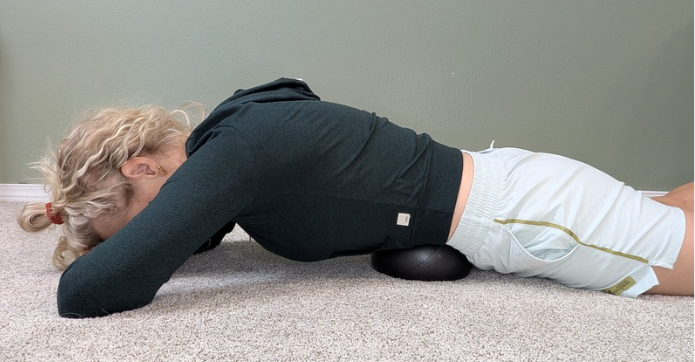
Grab a significantly deflated Pilates or Coregeous ball, place it over your belly button, and lie on your stomach. Take 10–20 slow, deep breaths, allowing your abdomen to expand in all directions as you breathe. Keep your body relaxed and the pressure comfortable.
2. Release your inner thighs.
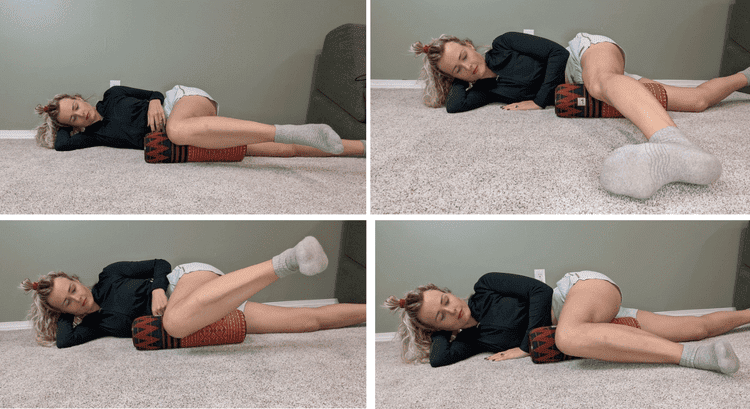
Roll onto your side and gently work on your adductors (your inner thigh muscles). Slowly bend and straighten your knee a few times, then rock your heel up and down. The mid-to-upper portion of the adductors can be a useful area to explore when you're experiencing lower back tension. If you need your leg propped up higher to get in this movement, set your roller on top of 1-2 pillows.
I’d love to hear how this goes for you, or what other areas of your body have been bothering you lately!
-
Because the movement that triggers the pain is not always the whole story. Your body may have been adapting to the same positions, movement patterns, and areas of tension for months or years. Eventually, one bend, twist, or reach can be the moment your body decides it no longer feels safe moving that way. That does not automatically mean something was seriously damaged.
-
No — not necessarily. Sudden pain can feel intense and scary, but pain alone does not tell you exactly what is happening structurally. Tight fascia, restricted movement, compensation patterns, and protective muscle guarding can all contribute to a back that suddenly feels locked or seized up.
-
Yes — it can. Fascia adapts to the positions and movements you repeat most often, and over time it can become restricted in ways that affect how freely your hips, pelvis, core, and spine move. Those restrictions can change how force is distributed through your body and contribute to lower back tension or pain.
-
Start gently. Instead of immediately forcing a stretch or trying to “crack” your back, focus on creating space and calming the surrounding tissues. Slow diaphragmatic breathing, gentle core release, and working on connected areas like the inner thighs can help reduce tension and give your body more options for movement.
-
The goal is not to avoid bending, twisting, or moving forever. It is to improve how well your body can adapt to those movements. Supporting fascial mobility, changing repetitive movement patterns, strengthening your body through a variety of ranges, and paying attention to areas of chronic tension can all help you move with more confidence and less fear.
