
Omg I FINALLY did it!!
A week and a half ago, I stood on the summit of Mt. Lindsey—my last of Colorado’s 58 fourteeners (the tallest peaks over 14,000 feet in the state).
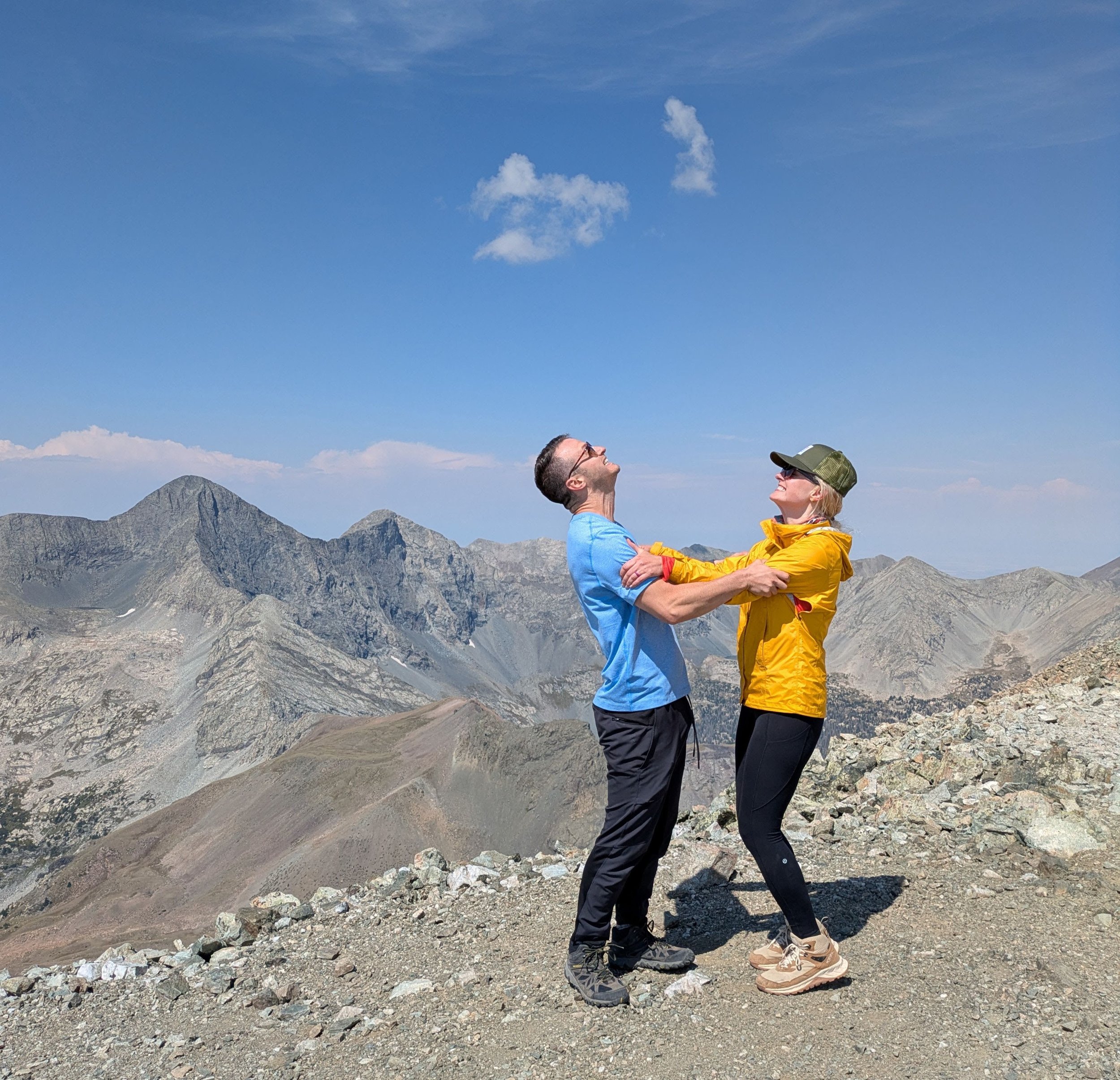
It took me 14 years.
After finishing Pyramid Peak two years ago, I had pretty much considered myself “done.” Mt. Lindsey had been closed for five seasons with no hint of reopening. But this summer, the gates opened again and the Achiever in me (hello, my fellow enneagram 3s ) couldn’t resist officially removing the asterisk from my list.
So Eric and I threw our gear in the car, drove four hours, and spent eight more on the trail. Just like that, I closed a huge chapter of my life.
Yes, I’m ecstatic. Yes, I’m proud.
And yes… I blasted We Are The Champions on the last few steps.
But the feelings have also been a bit complex, and I’ve really been sitting with what this whole journey has meant.
I've been thinking about lessons I want to carry forward like:
My body is capable and strong.
I can do hard things.
I can be scared and still stay calm and focused.
I can achieve any goal I set my heart on.
Nature is the ultimate reset button.
I can laugh during challenging moments.
I am mentally tough and adaptable AF.
And the lessons I'd like to leave behind like:
The journey has to be hard.
Push/endure no matter the cost.
Ignore my nervous system just to get it done.
Success means just “checking a box.”
When I started this quest, I felt like I had something to prove. Born with severe nerve damage in my arm, I’d carried the story that I was fragile. That there was so much that I "couldn't do." Bagging these peaks was supposed to show the world that I was capable.
But halfway through, something shifted. I realized I wasn’t doing this for anyone else. I was rewriting my story—not as breakable and limited, but as resilient, strong, and whole--and I was doing it for me.
It wasn’t always sunshine and rainbows. I battled brutal knee pain for two summers. (Like, my partner had to step on my calf or quad every 15 min on the way down to keep me walking.) I faced routes where my arm felt like a serious liability. I cried. I doubted. I walked 10 miles off Snowmass Peak with a broken arm. But the one lesson that rises above all others is this:
You don’t have to wait until you’re “healed” to start.
Healing isn’t a finish line—it’s a journey. And even in the middle of it, you can achieve incredible things.
So if you’ve been holding back from starting—because it feels too hard, like you shouldn't even bother, or you’re worried you’ll never be “done”—this is your reminder that you don’t have to be done healing to start living.
Sometimes, the journey itself is the healing.
P.S. Check out my reel of all my summit photos! Weeeeeeee!
-
Colorado’s 58 fourteeners are the mountain peaks in the state that rise above 14,000 feet in elevation. Climbing all 58 is a major goal for many hikers and mountaineers, and completing the full list is often seen as a huge personal milestone.
-
It depends on the person, experience level, access, weather, and life circumstances. For many people, finishing all 58 Colorado fourteeners can take years. This journey took 14 years, which speaks to how physical, emotional, and personal the goal can become over time.
-
Yes. Hiking can support mental health by reducing stress, building confidence, and creating space to process emotions. Time in nature often helps calm the nervous system, improve perspective, and remind people that healing and strength can happen at the same time.
-
Absolutely. Healing does not have to be complete before life begins. Many people learn that they can still pursue meaningful goals while working through pain, limitations, or recovery, as long as they are listening to their body and adapting when needed.
-
Because big goals often hold much more than the achievement itself. They can bring up identity shifts, old stories, grief, pride, relief, and reflection all at once. Reaching the finish line is not always just about success — sometimes it is also about realizing how much you changed along the way.
