
The only thing I ever quit…
I want to tell you a story about the first thing I’ve ever truly quit:
Running.
When I was 14, I fell in love with running through volleyball training. By my early twenties, it had become a huge part of my life. I had completed multiple half marathons and, in early 2014, right after opening my practice, I decided I was going to train for a full marathon.
Two weeks into training, my right knee started feeling tight during an “easy” run. I ignored it.
The next morning, I stepped out of bed, took one step toward the bathroom… and collapsed to the floor in pain. My knee hurt so badly I could barely limp into work that day.
Like many of us do, I went to a doctor hoping for answers. Maybe a tear. Maybe some obvious injury.
Instead, I got what felt like a very familiar non-answer:
“It’s IT band syndrome. Just stop running.”
Even then, something in me knew that could not possibly be the full story. If there was no distinct injury, maybe it wasn’t even a knee problem.
So I went home and started doing what I knew at the time: releasing as much fascia as I could.
And you know, it worked. Mostly.
After only a few months of consistent fascia release all over my lower body, the pain went away during everyday life. I could hike mountains, lift weights, play volleyball, and work long days in the office with no hint of discomfort.
But every single time I tried to run again, one of my knees would light up within minutes.
Eventually, I stopped trying.
And while that might not sound like a big deal, this was the first thing in my life I ever felt forced to give up. Not because I wanted to. Because it genuinely seemed like something my body could not do anymore.
Years went by.
Then, on New Year’s Day this year, something hit me:
It had been 13 years since I stopped running. I had officially spent the same amount of time not running as I had running.
Initially, I felt a wave of sadness wash over me. But then I suddenly had a very blunt conversation with myself:
“Wait… why am I still living by this story?”
Because the truth is, I know SO more now.
I understand fascia differently now.
I understand alignment differently now.
I understand compensation patterns differently now.
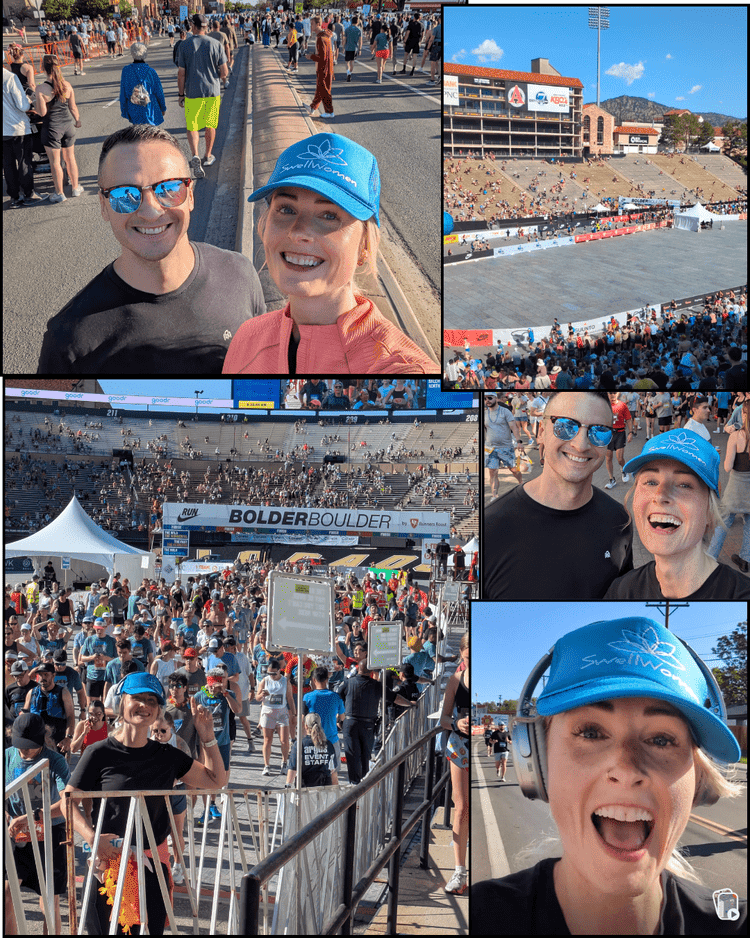
So on January 4th, fueled by this newfound realization, I signed up for the Bolder Boulder 10k
A few days later, I attempted my first run. I made it about 2 minutes before my left knee started burning so badly I had to limp home.
“Ok, pain’s still there,” I thought. Not a great starting point, but the one I was expecting.
Over the next few months, I worked on restoring alignment in my hips (because wow, they were off), releasing fascia strategically, and rebuilding balance and space in my body.
Then something incredible started happening.
5 minutes without pain.
Then 10.
Then 15.
And eventually… miles.
There were setbacks too. I broke a toe in March after kicking a door frame like a complete idiot and I strained my calf during one of my longer training runs only a month before the race.
But this past Monday, I crossed the finish line of the Bolder Boulder completely pain free.
Ten kilometers.
59 minutes.
Zero knee pain.
And while that may not sound particularly impressive to some people…it meant absolutely everything to me.
It had been over 13 years since I had felt my body carry me that far feeling strong, capable, and free.
I genuinely did not think I would ever run a race again. So yes… I’ll admit I absolutely teared up crossing the finish line.
I wanted to share this with you for two reasons:
First: understanding how to release fascia matters, but understanding where to release matters just as much.
Back in 2014, I did not yet understand the role that alignment imbalances and compensation patterns were playing in my body. Sometimes healing is not about “doing more” everywhere. Sometimes it is about understanding your unique pattern and addressing the actual root cause.
And second:
It is never too late to return to something you love.
I do not care if it has been 2 years, 10 years, or 20 years.
Your body is often capable of far more change than you have been led to believe.
Sometimes you just need the right information, the right strategy, and enough belief to try again.
If you need help understanding your pattern, please reach out. Let’s figure it out together.
-
Yes — it can. Knee pain is not always just a knee issue. A lot of the time, the problem is being influenced by fascial restriction, compensation patterns, and alignment issues happening elsewhere in the body. When you address the areas actually driving the stress pattern, the knee can finally stop taking the hit.
-
Because running can expose patterns that other activities do not. You may feel totally fine walking, lifting, hiking, or moving through daily life, but the repeated impact and mechanics of running can bring hidden imbalances to the surface very quickly. That does not automatically mean you are broken — it often means your body needs better support and a more specific strategy.
-
Absolutely. When the hips, pelvis, feet, or other parts of the body are out of balance, the knee often ends up dealing with extra stress. Over time, compensation patterns can create pain that keeps returning until the root issue is addressed. That is why treating the symptom alone does not always create lasting change.
-
Because sometimes it is not just about releasing more — it is about releasing the right areas. General fascia work can absolutely help, but if you do not understand the alignment issues or compensation patterns underneath the pain, you may only get partial improvement. Real progress often happens when the approach becomes more specific.
-
Yes — it can be. Even if it has been years, the body is often capable of more change than people think. With the right strategy, the right inputs, and a better understanding of your unique pattern, it may be possible to return to activities you thought were off the table for good.
